
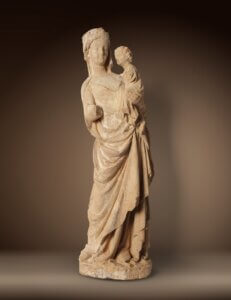
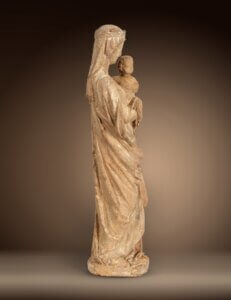
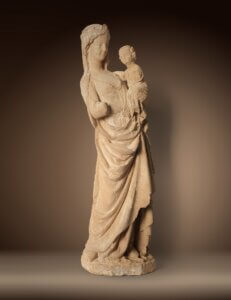
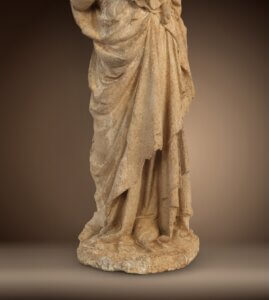
In 13th-century France, depictions of the Madonna occupied a central place within religious iconography. In contrast to the strictly frontal, enthroned “Sedes Sapientiae” depictions of the 12th and early 13th centuries, the standing, physically dynamic Mother of God increasingly came to the fore. Mary now appeared simultaneously as Queen of Heaven, Mother of Christ, and Intercessor for humanity. The growing sense of human closeness between mother and child illustrated the mystery of the Incarnation: through Mary, the divine Christ had become visibly and physically human. The crown and upright posture preserve the majesty of the Mother of God, while physical contact, glances, and the child’s animated movements emphasize her maternal and mediating role. French sculpture increasingly developed slender proportions, a more relaxed posture, and complex drapery movements for this subject.
Context: Paris
Paris played a particularly significant role in this context. In the third quarter of the 13th century, the royal residence—and especially the area surrounding the Sainte-Chapelle—became a leading center of courtly, refined sculpture. At the same time, Paris became the leading center of Gothic ivory carving. Statues of the Madonna transposed the forms of monumental sculpture into a precious medium intended for private devotion. Their characteristic lateral curve often follows the natural curvature of an elephant’s tusk: Mary’s body leans over her supporting leg, while the Child is cradled on her opposite hip.
Mother and Child
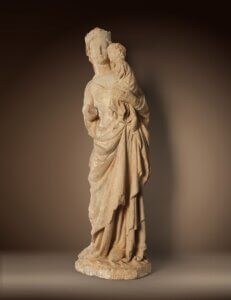
Mary stands in a slight contrapposto on a flat base. Her weight rests on her supporting leg, while her slightly bent free leg extends from beneath her robe, lending her elongated body a gentle, dynamic sway. This movement is accentuated by the lateral pull of the child, whom Mary holds close to her torso in her left arm. Despite this physical liveliness, the Mother of God maintains an elegant calm.
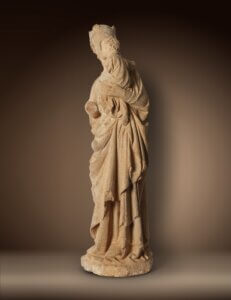
Mary is wearing a dress that fits snugly across her upper body and is cinched at the hips with a belt. Over it is a long cloak that falls from her shoulders and forms a deep, bowl-shaped fold at her hips. From there, the hem runs diagonally across her legs. This diagonal line emphasizes both Maria’s hip curve and the elevated position of the child, who is also dressed in a long robe. The treatment of the fabrics is one of the sculpture’s outstanding qualities. Across the chest and shoulders, the robe lies almost flesh-like and “wet,” hinting at the underlying anatomy. Below the hips, however, the cloak gains considerably more volume. A sequence of rounded and angularly broken box pleats flows down from the hip area to the free leg. These configurations are separated by deeper folds and create a lively interplay of light and shadow. At the standing leg, the coat fans out into lush, nearly tubular folds. The hems meet the floor in thin, flatly spread panels. It is precisely this contrast between voluminous masses of fabric and the almost gossamer-thin, tapering edges of the folds that attests to the sculptor’s high level of technical mastery and the remarkable translation of textile qualities into stone.
The drapery thus serves several functions: it lends the heavy cloak a believable sense of weight, guides the viewer’s gaze through the figure in a dynamic movement, and at the same time highlights the infant Jesus. The robe is not merely an ornamental surface, but mediates between body, movement, and space. The slender curve of the figure as a whole is immediately reminiscent of contemporary ivory Madonnas. While the curvature in those figures is materially determined by the shape of the tusk, in the stone figure it is a deliberate sculptural choice and thus, in all likelihood, the transposition of a familiar silhouette into the medium of stone.
Physiognomy and Iconography
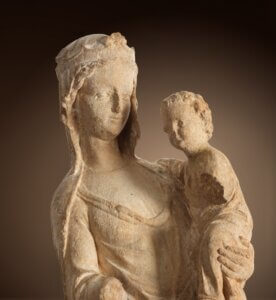
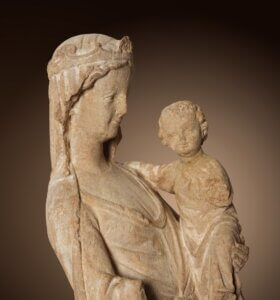
A narrow crown band rests on Mary’s head, identifying her as the Queen of Heaven. Beneath it, a headscarf falls in gentle waves over her hair and shoulders, blending visually into her cloak. While the scarf fits snugly against her head at the front, it is depicted as more voluminous and slightly puffed out at the back. Beneath its edge, individual curls emerge at her forehead, framing her face. Mary’s features correspond to the courtly ideal of beauty in the Gothic period: above her high forehead, narrow yet sharply contoured eyebrows are visible. Her elongated, almond-shaped eyes rest beneath accentuated eyelids. A small, upturned nose leads to a narrow mouth, the corners of which curve upward into a reserved smile, forming small dimples. Mary tilts her head slightly toward the child. The child does not immediately return her gaze but turns his round face outward and downward. Its short hair is arranged in small curls; the full cheeks and softer contours distinguish its childlike features from the mother’s more pronounced facial features. With its right hand, it clasped Maria’s shoulder. The gesture seems exceptionally intimate: the child is visibly seeking physical comfort from his mother and, in doing so, is forming a deep bond with her.
The foot, angled downward, deserves special attention, as it reveals the child’s bare sole to the viewer. The visibility of the bare foot first and foremost emphasizes Christ’s actual physicality and thus his human nature. Comparable Parisian ivory Madonnas explicitly associate the small, uncovered feet with the Incarnation and the fleshly existence of the Son of God. Depending on the context of the image, the visible foot could also allude to the future Passion, since Christ’s feet were later to be pierced by the nails of the cross. The sole of the foot should therefore not be understood as a casual naturalistic detail, but rather as a subtle theological reference to the Incarnation and redemption.
The intimate physical bond between mother and child is also linked to Mary’s role as intercessor. She carries and presents Christ to the faithful, while her downcast gaze emphasizes her relationship with her Son. The child, on the other hand, opens up the group by turning sideways toward the viewer’s space. The bowed heads, the visible sole of the foot, and the highly sculptural rendering of the lower parts of the garments suggest that the figure was originally conceived for an elevated location and thus for viewing from a slight low angle.
Stylistic Classification
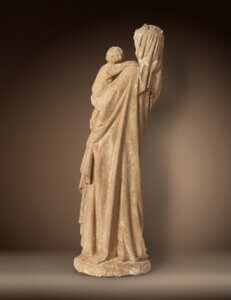
The most striking comparison is with the Ivory Madonna from the Sainte-Chapelle (Louvre, Inv. No. OA 57), followed by the Madonna at the Metropolitan Museum of Art (Inv. No. 17.190.175). Similar features include the curved silhouette, the position of the child on her hip, the short, wavy headscarf, the narrow facial type, and the combination of close-fitting fabric panels with deep box pleats. Not only the right arm bent beneath the cloak, but especially the design of the headscarf at the back can be cited as a distinctive stylistic feature. Two nearly parallel, downward-opening tubular folds meet there and frame a flatly modeled section of fabric in the center of the back. This striking similarity suggests that the work was created in a closely related stylistic or workshop-based context. A comparable example in wood is the so-called Vierge de Wargnies (Louvre, Inv. No. RF 1449), whose drapery configurations, as well as the rendering of the headscarf on the back, appear closely related. A particularly close typological parallel is also provided by the so-called Vierge au pied d’argent (Inv. No. B 445) from the former Abbey of Saint-Corneille in Compiègne, now in the Musée du Cloître Saint-Corneille. Dated to around 1270, this stone Madonna belongs to the stylistic movement that developed in the third quarter of the 13th century within the artistic circles of Paris and Île-de-France and quickly spread to neighboring regions. The adoption of this stylistic language in Compiègne was likely facilitated by the close ties between the Abbey of Saint-Corneille and the French royal court, by the mobility of sculptors and workshop members, and by the circulation of small-scale sculptures, particularly those carved from ivory. The similarities between the works mentioned show that certain formal solutions were not tied to a single material but were transferred between ivory, wood, and stone sculpture and further developed in each case in a manner specific to the material.
The stylistic and typological similarities make it possible to place the figure within the context of those depictions of the Madonna that originated in Paris and the Île-de-France around 1260–1270, within which it stands as a significant example of the translation of this courtly stylistic language into stone.