
Jean François de Troy is considered one of the most versatile and significant French painters of the early 18th century. As the son of the renowned portraitist François de Troy, he received his early training in his father’s studio before a lengthy stay in Italy (1699–1706) had a decisive influence on him. In 1708, he was admitted to the Académie royale, and in 1738 he was appointed director of the Académie de France in Rome, where he remained active until his death. De Troy was highly regarded both as a portraitist and as a creator of historical paintings, mythological and religious scenes, and elegant genre depictions. His painting combines the decorative richness and colorfulness of a Paolo Veronese with the dynamic sensuality of a Peter Paul Rubens. Contemporaries regarded him as one of France’s leading painters, whose work contributed significantly to the development of French painting in the 18th century.
The theme of the Muses originates in ancient mythology: as the daughters of Zeus and Mnemosyne, they embody the arts and sciences. In 17th- and 18th-century European art, they frequently appear in allegorical depictions that combine both decorative and intellectual elements. While the muse of love poetry—Erato—the muse of choral poetry and dance—Terpsichore—and the muse of song—Polyhymnia—are often depicted with musical instruments, the muse of historiography — Clio — and the muse of epic poetry—Calliope—are frequently accompanied by attributes of intellectual creation, such as a stylus and a manuscript. Such combinations point to the harmonious interplay between music and poetry, two closely related arts.
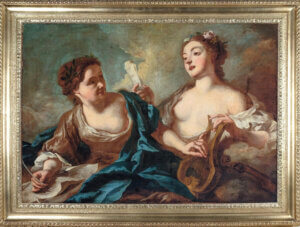
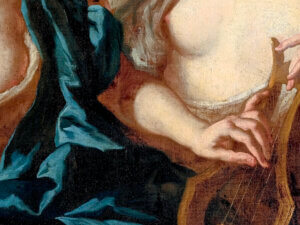
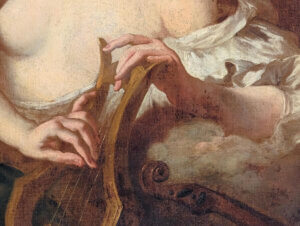
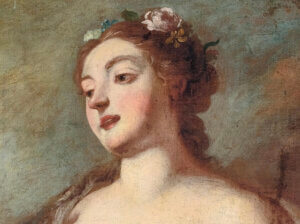
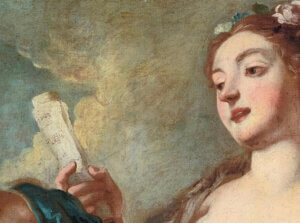
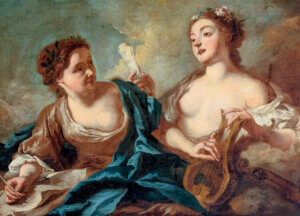
This painting depicts two female figures facing each other and apparently in conversation, set against a dynamic, cloudy sky. On the right side of the painting appears the muse of music, likely Euterpe, half-naked, covered only by a white robe draped lightly over her shoulders. Flowers are woven into her artfully braided hair, including a delicate pink rose. In her right hand she holds a rolled-up sheet of music, while her left hand cradles a lyre; a violin can be seen beside it. With raised eyebrows, open eyes, and a slightly parted mouth, she faces her companion in three-quarter profile, as if engaged in a lively exchange.
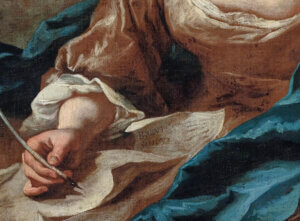
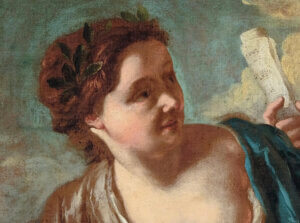
The second muse on the left side of the image is also depicted in three-quarter profile and is turning toward the first. Her braided brown hair is adorned with laurel leaves, a classic symbol of poetic inspiration. She partially bares one breast, while a blue cloak is loosely draped over her robe. With her left hand, she plucks the strings of the instrument, while she supports herself with her right elbow and writes with a stylus on a sheet of paper on which several lines are already visible.
This work is a high-quality variation on a painting by de Troy in the New Orleans Museum of Art. The attribution is also supported by stylistic comparisons with other confirmed works by the artist, such as the *Allégorie de la Force et de la Tempérance* at the Château d’Aulteribe (Sermentizon). There, one can see comparable poses, a similar treatment of the robes with their vibrant colors, and a sky rendered in a similar manner with soft modeling. The facial features of the figures—particularly those of the muse on the right—as well as the finely rendered flesh tones also show clear parallels. The combination of two allegorical figures also reflects the artist’s practice of creating pairs (pendants) with morally or intellectually charged themes.
De Troy’s painting is characterized by an elegant, flowing brushstroke and a rich yet harmonious color palette. His compositions combine decorative grace with narrative clarity and reflect the transition from the austere history painting of the 17th century to the lighter, more gallant visual concepts of the 18th century. Despite growing criticism of allegorical depictions over the course of the century—for example, by Abbé Du Bos or Denis Diderot—the genre remained in demand due to its representational and intellectual qualities. Works such as this one demonstrate the enduring fascination with allegorical themes, which, in de Troy’s hands, attain a particular elegance and artistic sophistication.
Bibliography: Christophe Leribault, Alastair Laing, Jean-François de Troy, 1679–1752, Paris, Arthéna, 2002.