
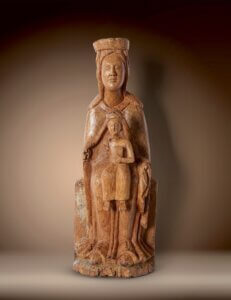
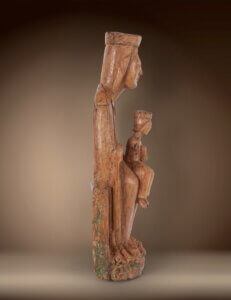
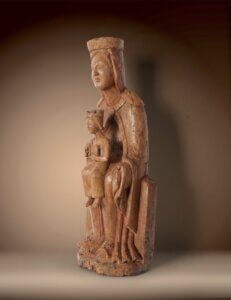
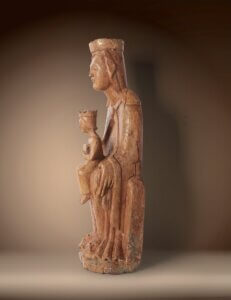
The Enthroned Madonna – Sedes Sapientiae
France, Brittany
Late 12th century
Wood carving with traces of polychrome paint
Height 61 cm
Provenance: probably Pornic, historic Brittany; by 1927 at the latest, collection of Dr. John E. Stillwell, New York
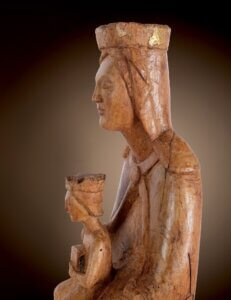
The enthroned Madonna, with the infant Christ seated facing her on her lap, belongs to the medieval iconographic type of the *Sedes Sapientiae*, the “Throne of Wisdom.” The term is based on the idea that Mary does not merely sit on a throne, but herself forms the throne of the divine Word made flesh. Christ appears as the embodiment of divine wisdom. This iconographic type thus links the veneration of Mary with the central Christian doctrine of the Incarnation. Such enthroned Madonnas became particularly widespread in the churches of Western and Central Europe during the 12th century. Their impact stems from their strict frontal composition, symmetry, and hierarchical order. Mary appears as the Mother of God and Queen of Heaven, while Christ is depicted as a small-scale ruler and teacher. This iconographic type was particularly popular in the 12th century.
Description
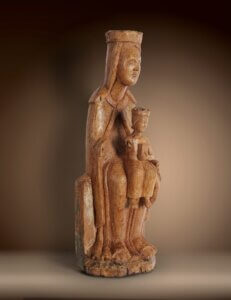
Mary sits in an upright, dignified posture on a broad, block-like throne. The throne unites the group into a cohesive composition, and its architectural unity enhances the monumental appearance of the Mother of God.
A wide crown rests on Mary’s head, identifying her as the Queen of Heaven. Beneath it, a thick veil fits snugly against her head and falls over her neck and shoulders. Her hair peeks out above her forehead, adding a touch of liveliness to her otherwise austere appearance. Her elongated face is defined by arched eyebrows, almond-shaped eyes, a straight nose, and a small mouth. Her impassive expression is meant to convey a sense of timeless dignity.
Mary is wearing a long robe and, over it, a heavy cloak fastened across her chest with a large round clasp. The fabric panels are rendered flat and two-dimensional. At her side, Mary appears to be holding the hem with her left hand, which is depicted as disproportionately large. Two parallel, symmetrically arranged panels of fabric run vertically across her lower body, emphasizing its frontal orientation. Between her knees, the robe falls in long, straight panels; and above her feet, it widens into soft, almost dough-like fanned folds. The shoes protruding from beneath the fabric and the cloak hems extending downward at the sides form a rhythmically structured conclusion.
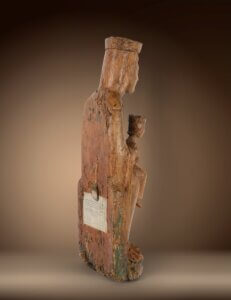
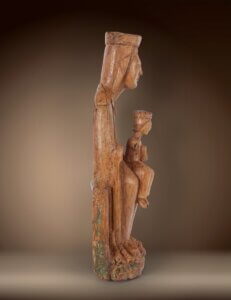
The infant Jesus is enthroned in the center of Mary’s lap. His strictly axial position is characteristic of the *Sedes Sapientiae* type: he forms the spiritual and compositional center of the entire painting. Mary thus literally appears as his throne. Christ, too, wears a long robe and a tall crown, from beneath which his short hair peeks out. With his left hand, he presses a closed codex to his chest. This can generally be understood as a symbol of the divine Word and the teachings of Christ. His right hand may originally have been raised in a gesture of blessing. The legs, hanging straight down, extend the vertical central axis of the composition all the way to the pedestal.
Both the mother and the child are facing directly toward the viewer. There is neither eye contact nor narrative interaction between them. Rather, their connection is expressed through the strict superimposition of figures and the unified silhouette of the group. Mary presents Christ as the Logos made flesh, while his crown and book identify him as both king and teacher.
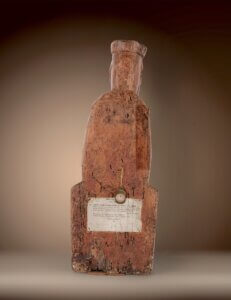
The back is flat. This suggests that the sculpture was intended to be displayed primarily from the front, possibly in front of a wall, in a shrine, or on an altar. Traces of an older polychrome paint scheme have been preserved on the surface. In particular, the gold on the crowns and the green of the base reveal that the figure originally had a striking chromatic effect.
Historical Origins and Early Documentation
On the back is a historical label indicating that it comes from Pornic. This port city is located in the Pays de Retz on the southern edge of historic Brittany and is now part of the Loire-Atlantique department. The term “Lower Brittany” used on the English-language label is geographically vague, as Pornic is usually considered part of Haute-Bretagne or the southern gateway to Brittany. It should likely be understood as an older, general term indicating origin from the Breton region.
The note does not specify a particular church, but it does suggest two historic religious buildings as possible former locations: Both the church in the Upper Town, which has existed since the 10th century and was the predecessor of the later Church of Saint-Gilles, and the Romanesque Abbey Church of Sainte-Marie, built in the 12th century. The dedication to the Virgin Mary and the chronological overlap with the Romanesque church construction make the abbey context particularly worthy of consideration.
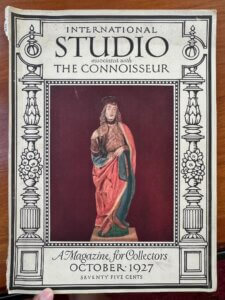
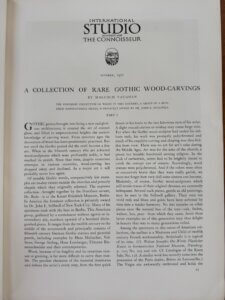
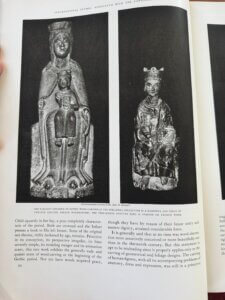
The early photographic documentation of the sculpture is of particular significance. In October 1927, it was featured in Malcolm Vaughan’s article “A Collection of Rare Gothic Wood-Carvings” in the journal *International Studio, associated with *The Connoisseur *. At that time, the work was part of Dr. John E. Stillwell’s New York collection and was presented as its earliest French wood sculpture. The 1927 publication already highlighted the child’s central position, the crowns worn by the mother and son, the codex pressed to the chest, and the remnants of the original paint. The publication confirms its inclusion in a significant early American collection of medieval wood sculptures.
Classification and Comparison
The Madonna follows the tradition of French Romanesque *Sedes Sapientiae* sculptures. For iconographic and compositional comparisons, see the *Vierge en Majesté*, created around 1150 in Auvergne and now in the Musée du Louvre (Inv. No. RF 987), the Enthroned Madonna at the Metropolitan Museum of Art (Inv. No. 67.153), and the so-called Morgan Madonna from around 1175–1200 in the same museum (Inv. No. 16.32.194a, b). What they have in common is the frontal arrangement of mother and child, the architecturally rendered throne, and the depiction of Christ as a regal embodiment of divine wisdom.
These works should not be viewed as direct comparisons of workshops. Rather, they illustrate the iconographic context in which the group of figures from Pornic is situated. In contrast to the often more rhythmically draped garments of the Auvergnat figures, it is characterized by flatter modeling, reduced drapery, and an almost architectural unity. This formal rigor could indicate an independent regional interpretation of the widespread iconographic type in a Breton or western French workshop.
With its uncompromising frontal composition, the rare depiction of the mother and child both crowned, its early documentation in the Stillwell Collection, and its attested provenance from Pornic, this Madonna represents an exceptional example of the French *Sedes Sapientiae* style of the late 12th century. Possibly created for the Romanesque abbey church of Sainte-Marie, it preserves, with striking unity, the iconographic concept in which Mary herself becomes the throne of the divine Word made flesh.