
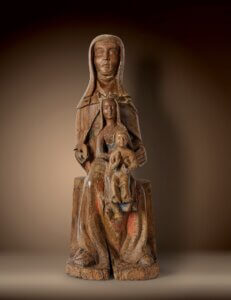
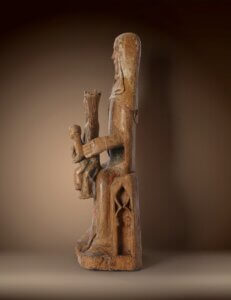
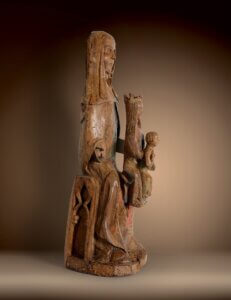
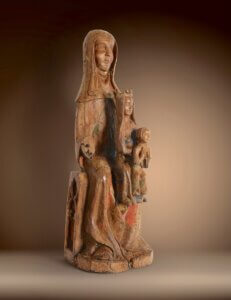
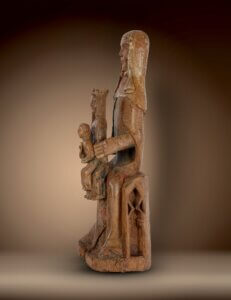
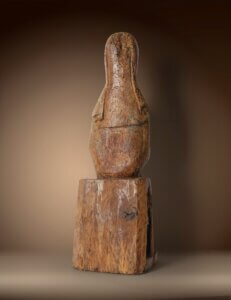
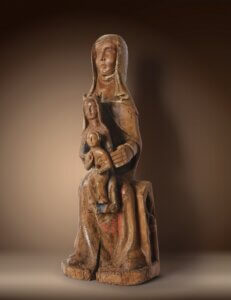
Possibly the earliest known depiction of Saint Anne with the Virgin and Child
Pilgrimage Route Network (presumably in southwestern France)
Around 1200
Carved walnut with remnants of polychrome paint
Height 63.5 cm
The depiction of Saint Anne with her daughter Mary and the infant Jesus—referred to as “Anne and the Three”—illustrates Christ’s direct human lineage spanning three generations. Saint Anne is shown here not merely as the grandmother of Jesus, but as the starting point of his earthly genealogy and thus as the source of his humanity. This depiction gained increasing significance over the course of the 13th century. The interlocking composition unites the three figures into a cohesive genealogical unit: Anna holds Mary, and Mary holds Christ.
This iconographic type unmistakably draws on the earlier Romanesque depiction of the *Sedes Sapientiae*, the “Throne of Wisdom.” In this depiction, Mary appears as the throne of the divine Logos made flesh. In the “Anna in the Triangle” depiction, this principle is expanded to include another generation: Anna, as it were, forms Mary’s throne, while Mary, in turn, carries Christ. The hierarchical scaling down of the figures makes the generational sequence immediately apparent and, at the same time, lends the depiction a strictly theological order.
Description
Saint Anne sits on a block-like throne with architecturally structured armrests, in a strictly frontal and upright posture. Anna dominates the composition through her monumental size. In front of her elongated torso, Mary and the infant Jesus are arranged one above the other on a much smaller scale. Mary, depicted as a child, sits centrally on Anna’s lap, between her spread legs and feet. The infant Jesus, in turn, appears on Mary’s lap. The composition follows an almost perfect central axis, from which only the infant Jesus—slightly shifted to the side—stands out. It is precisely this slight shift that enlivens the otherwise strictly symmetrical and closed group.
Anna wraps her left arm protectively around Mary and Christ. Her fingertips reach all the way to the child’s body, thus establishing a direct connection between the oldest and the youngest generations. The right hand, which is no longer preserved, would likely have originally mirrored or complemented this enveloping gesture. Mary and the Child are held and embraced by it. The strict frontal composition, the symmetrical basic arrangement, and the hierarchical proportions correspond to a formal language shaped by the Romanesque conception of imagery.
Based on the remnants of the painting visible today, Anna originally wore a white headscarf, a green robe, and a red cloak. The white of the headscarf may symbolize purity, virtue, and spiritual dignity. Green signifies life and hope and seems particularly fitting in the context of Anna, as she is regarded as the origin of Christ’s human genealogy. The red cloak may represent love, but also the future Passion of Christ. Mary is highlighted by her blue robe and her French-style crown: blue came to be increasingly associated with heaven, divine wisdom, and the special dignity of the Mother of God, while the crown distinguishes her as Queen of Heaven. The infant Jesus was wrapped in a green robe, which parallels Anna’s dress. The color gradation thus also reinforces the group’s order within the history of salvation: Anna appears as the genealogical origin, Mary as the royal Mother of God, and Christ as the incarnate Savior.
On the legs of the three figures, the garment falls in angular, jagged folds bordered by high ridges. Despite their geometric arrangement, the folds possess a soft, almost dough-like texture. The panels of the robes do not lie thinly over the bodies but appear as heavy, independent masses. Beneath Anna’s robe, her pointed shoes emerge symmetrically on both sides. The vertical division between the legs reinforces the monumental frontal view and the formal unity of the sculpture. The infant Jesus sits upright on Mary’s lap. His right hand is raised in a gesture of blessing, while his left arm is bent in front of his body and likely held an attribute such as the orb or a fruit. This posture identifies Christ as the blessing Savior.
Physiognomies
Anna’s elongated face is framed by a tight-fitting white headscarf that completely encloses her head, covers her neck below the chin, and rests on her shoulders in flat, largely symmetrical folds. The veil identifies her as a married, older woman and clearly distinguishes her from the youthful Mary. Her face is characterized by large, almond-shaped eyes. Her strong, straight nose transitions into a distinctly prominent philtrum, beneath which lies her narrow mouth. Her eyes, fixed intently on the viewer, and her largely impassive expression give Anna a dignified, almost ethereal appearance.
Maria has a slimmer, more youthful face. Her almond-shaped eyes are smaller than Anna’s; her short, slightly upturned nose and small mouth soften the stern frontal pose. She wears a crown on her head, though she does not wear a headscarf beneath it. Instead, long, straight strands of hair fall down on either side of her face. This contrast with the fully veiled Anna highlights both Mary’s youth and her status as a virgin.
The child’s face is framed by a center part and straight strands of hair that reach down to the ears. His large eyes, prominent nose, and clearly defined mouth give him features that are less childlike and more regal. Thus, his physiognomy also fits into the Romanesque tradition of depicting the child as divine wisdom.
Stylistic and Typological Classification
As early as the 8th century, murals in Santa Maria Antiqua in Rome depict Saint Anne with her daughter Mary; however, these do not yet represent the later iconographic type consisting of three generations arranged one behind the other. This motif could not be definitively identified as a distinct sculptural composition until the 13th century. Among the earliest recognized sculptures are the monumental stucco “Anna selbdritt” in St. Nikolai in Stralsund, dated to around 1260–1270, as well as the group from the Rhine-Meuse region, created around 1290 and housed in Frankfurt’s Liebieghaus, and the group from around 1230 from the Puster Valley, now in the Mining and Gothic Museum in Leogang.
This figure can be stylistically dated to around 1200 and could thus be the oldest surviving sculptural depiction of the “Anna selbdritt” in existence. Its significance would then lie in a surprisingly early, almost programmatic expression of that iconographic concept, which did not become widely prevalent until decades later: Anna carries Mary, Mary carries Christ—the human lineage of the Savior is visualized as a closed, physically intertwined succession of generations. The compositional basis for this is the Romanesque *Sedes Sapientiae*, the “Throne of Wisdom.” The hierarchical reduction in the size of the figures, their arrangement along a common central axis, and the blessing Christ Child should therefore not be understood as a mere repetition of a Madonna group, but rather as a logical further development of one of the central Romanesque depictions of the Virgin Mary.
Several early *Sedes Sapientiae* groups can be used for typological comparisons: the *Vierge en Majesté* from Auvergne, created around 1150 and now in the Musée du Louvre (Inv. No. RF 987), the Enthroned Madonna from c. 1150–1200, also from Auvergne, in the Metropolitan Museum of Art (Inv. No. 67.153), and the *Virgin and Child in Majesty* from around 1175–1200, also housed there (Inv. No. 16.32.194a, b). What they have in common is the strictly frontal arrangement of mother and child, the block-like unity of form, and the depiction of Christ as a small-scale yet regal figure. Furthermore, they are all carved from walnut. Walnut was frequently used, particularly for Romanesque Marian figures in central and southern France. Therefore, the choice of wood supports their classification within the French artistic tradition.
For the northern Spanish Pyrenean region, the two Madonnas of Ger and Gósol, created in the second half of the 12th century and now in the Museu Nacional d’Art de Catalunya (inv. nos. 065503-000 and 015936-000), respectively, are particularly revealing. Here, too, Mary and Christ are depicted stacked axially one above the other, seated on an architecturally rendered throne and connected by a hieratic frontal pose. However, the facial features in this example are significantly more refined, and the crown is designed with extreme delicacy.
A possible area of origin between southern France and northern Spain
The connection with the region spanning southern France and northern Spain seems worth considering, not least because a particularly rich tradition of polychrome, enthroned statues of the Virgin Mary developed there in the 12th century. However, this region should not be understood as a narrow, straight “pilgrimage route.” Rather, the routes to Santiago de Compostela formed a widely ramified network of main and secondary routes, episcopal cities, monasteries, markets, and regional pilgrimage sites. This network was traversed not only by pilgrims, but also by clergy, artisans, merchants, relics, portable works of art, and knowledge regarding the production of sculptures. It is therefore possible to highlight the mutual cultural exchange between the Iberian Peninsula and the rest of Europe, as well as the role of the Way of St. James as a religious and commercial axis.
This figure appears not only to have adopted the earlier Romanesque Madonna model but also to have expanded upon it in an extraordinary way. The monumental figure of Saint Anne replaces Mary as the outermost and largest “throne,” while the crowned Mother of God, depicted in a girlishly diminutive form, sits before her and in turn holds the blessing Christ. Such a composition could have originated in a milieu where the Sedes Sapientiae was firmly established, yet at the same time new forms of genealogical and Marian devotion were being adopted. The region of southwestern France, the Pyrenees, or northern Spain offers a plausible context for its creation. As possibly the earliest surviving sculptural representation of the “Anna selbdritt,” the group occupies a prominent position in art history: It transforms the hieratic order of the Romanesque Sedes Sapientiae into an image of Christ’s human genealogy that is as monumental as it is innovative, and may have been created within one of the most significant artistic and religious networks of medieval Europe.